
The hidden factor that skews engagement and satisfaction scores—and how to fix it before you waste resources.
The Survey Trap
Most organizations rely on engagement or satisfaction surveys to guide culture initiatives and planning. The logic seems sound: if a score is low, fix that area and morale will rise. But research by Cucina, et al., 2025 shows these surveys often measure more than they appear to—sometimes what they mostly measure is one big thing: a dominant general factor (the “a factor”) that reflects overall sentiment toward the organization and systematically influences responses across many items. In their example analyses of the Federal Employee Viewpoint Survey, this general factor explained a large share of variance across items and scales (often exceeding 50%), meaning many scores tend to rise or fall together when overall sentiment shifts (Cucina et al., 2025).
When leaders ignore the a factor, they risk acting on misleading patterns and investing in changes that don’t address the real issue.
One Factor, Many Questions
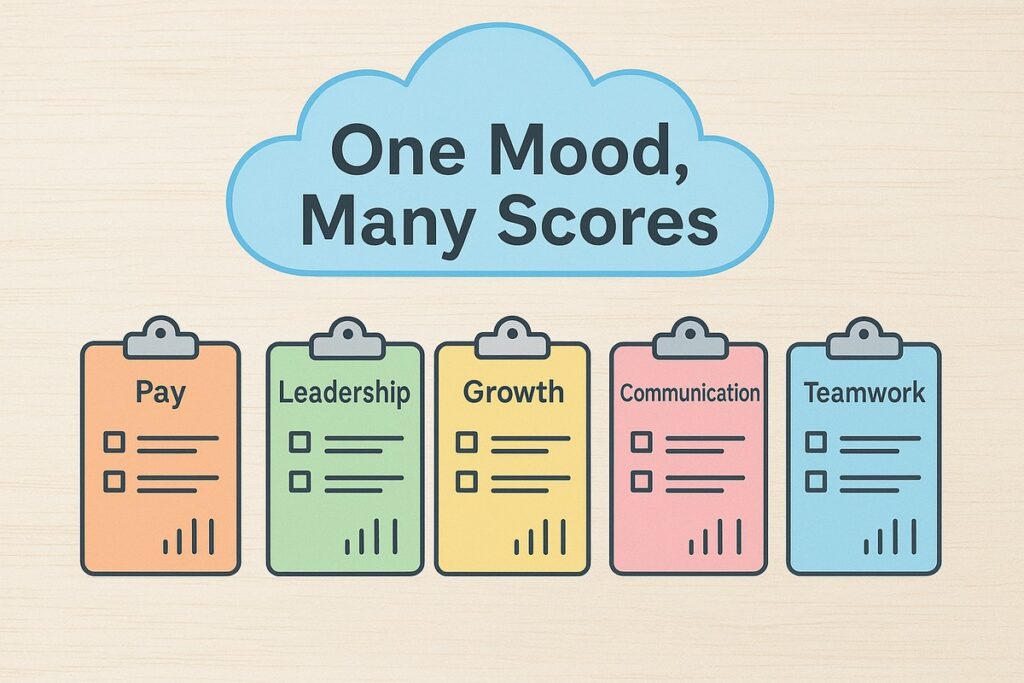
Because the a factor reflects overall attitude toward the organization, it can pull most item scores in the same direction—pay, communication, leadership, growth, teamwork—making distinct issues look uniformly weak (or strong). Adjusting for the a factor (i.e., analyzing residualized scores) helps isolate which topics are specifically underperforming versus which are low because overall sentiment is low.
A Common Scenario: The Pay Satisfaction Trap
A company sees only 44% of employees agree with “I am satisfied with my pay and benefits.” Leadership increases salaries and perks, but six months later overall engagement barely moves. A factor-analytic review shows a strong a factor pulled most items down, including trust in leadership and communication. Pay was a symptom, not the root cause.
Why This Matters for Employers
- Resource allocation: Avoid spending heavily on a single item if the broader sentiment is the true driver.
- Strategic clarity: Organization-wide drivers (e.g., leadership trust, transparency, fairness) can lift many scores at once.
- Better prioritization: Residualized (adjusted) scores reveal which topics are uniquely weak.
How to Spot the a Factor in Your Data
- Parallel movement: If most items rise/fall together across cycles, a general factor is likely.
- Ask your vendor/analyst: Confirm they run PCA/CFA and can provide a factor–adjusted scores.
- Compare levels: Review an overall sentiment index alongside item/scale results before planning interventions.
What Realistic Hypothetical Data Looks Like
In today’s environment, adjusting for the a factor typically shifts item results by 5–15 percentage points—enough to change priorities but not so large that it flips conclusions.
Important note: The figures below are illustrative only to show how interpretation can change. They are not results from the Cucina et al. (2025) study.
| Survey Item | Raw % Agree | Adjusted % Agree (a factor removed) |
| Pay & Benefits Satisfaction | 44% | 52% |
| Trust in Senior Leadership | 47% | 55% |
| Career Growth Opportunities | 45% | 50% |
| Effective Communication | 46% | 53% |
| My Team Works Well Together | 51% | 58% |
Reading: The adjusted view shows pay is not uniquely low; trust and communication also require attention—pointing to broader culture work, not only compensation.
A Limitation Worth Noting—and How to Address It
What the study does: It detects and quantifies a dominant general factor and shows that item/scale scores change when you account for it.
What it does not do: It does not test whether the differences between raw and adjusted scores are statistically significant—that was outside the study’s scope (Cucina et al., 2025).
What employers should do on their own data:
- Run paired comparisons (e.g., paired t-tests or Wilcoxon signed-rank tests) on raw vs. adjusted scores.
- Calculate effect sizes (e.g., Cohen’s d) to judge practical importance.
- Use confidence intervals around differences to understand precision.
- Triangulate with qualitative evidence (comments/focus groups) and behavioral metrics (turnover, promotions, absenteeism).
Key point: Statistical significance is not the only lens. Combine significance, effect size, and context to decide if a difference warrants action.
Turning Insight into Better Action
Identifying the a factor separates symptoms (low scores caused by overall sentiment) from specific issues requiring targeted intervention. Apply it with discipline:
- Prioritize by adjusted scores.
- Use a factor–adjusted results to rank issues. If pay is 44% (raw) but 52% (adjusted) and trust is 47% (raw) and 55% (adjusted), do not over-index on pay; both are sentiment-affected, and trust/communication may be the true leverage points.
- Remediate the drivers of overall sentiment first.
- Typical drivers: leadership trust, organizational transparency, workload/process fairness, recognition, and career pathways.
- Convert to actions with owners and metrics, e.g.:
- Quarterly town halls with open Q&A; publish Q&A transcripts and commitment trackers.
- Leader 30/60/90-day action plans tied to survey themes; report completion rates.
- Transparent promotion criteria; quarterly internal mobility reporting.
- Use raw scores for messaging; use adjusted scores for investment decisions.
- Raw = how employees feel now (acknowledge concerns credibly).
- Adjusted = where dollars and time should go for durable impact.
- Cross-validate with hard metrics.
- If career growth (adjusted) is low and internal promotion/transfer rates are low, prioritize internal mobility changes.
- If communication (adjusted) is low and change-adoption metrics lag, prioritize manager enablement and change comms.
- Track two curves across cycles: the a factor and the targeted items.
- If the a factor improves, expect broad lift.
- If only one or two items improve while the a factor is flat, you solved a narrow problem; expand to culture-level work.
- Report both curves to executives to maintain focus on enterprise-level levers.
The Bottom Line
Employee surveys are powerful only when analyzed and interpreted correctly. Accounting for the a factor transforms a list of low scores into a targeted plan: fix the culture-level drivers that depress everything, then fine-tune specific topics. Pair statistical testing with effect sizes and context to make confident, high-ROI decisions.