
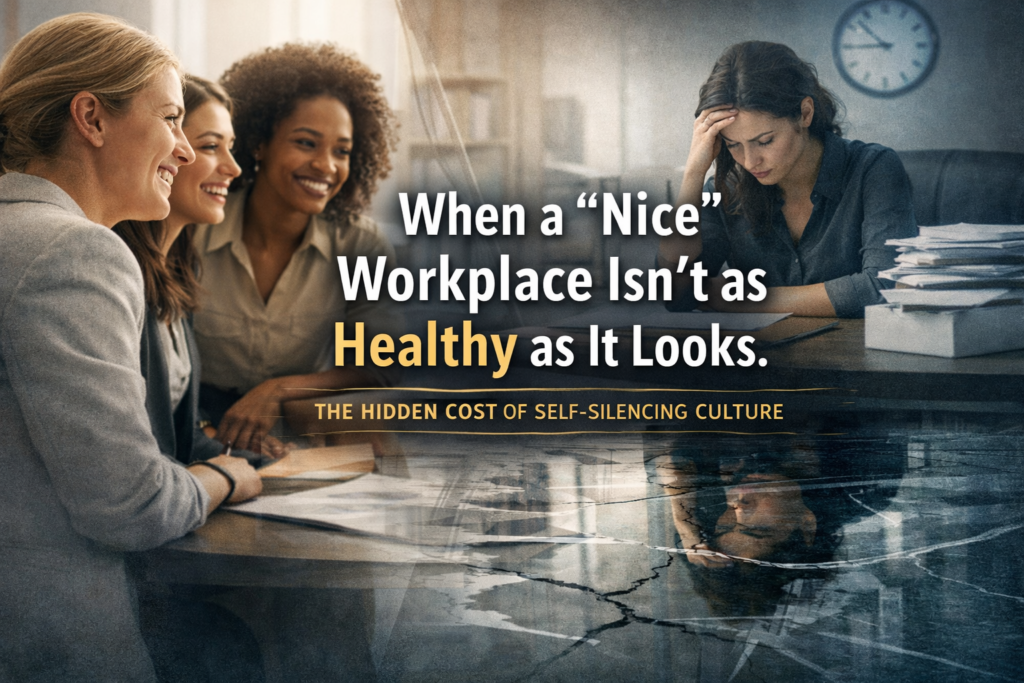
A warm workplace is not always a healthy one. Research on femininity workplace culture reveals how self-suppression, burnout, and hidden strain can develop beneath a supportive surface.
Femininity Workplace Culture
Most organizations want a workplace that feels collaborative, respectful, and supportive. Some workplaces can appear warm and cooperative while still producing a steady undercurrent of strain. Employees may look composed, agreeable, and highly relational, but that does not always mean the culture is psychologically healthy. Sometimes it means people have adapted to an unspoken set of rules about appearing pleasant, accommodating, and emotionally contained.
Case example
Maya is a nurse on a unit with a women-led management team that prides itself on being “like family.” After a colleague is suddenly let go, her manager asks if staff, including Maya, can pick up one extra shift each week “just for a while.” The request is wrapped in values: patient care comes first, and everyone has to “do what it takes” to protect the unit’s standards. Maya is dependable and cares about patients—so she says yes as do some of the other female staff. Maya notes that the male staff do not “volunteer”.
Weeks turn into months with no new hires. The requests keep coming, framed as “I hate to ask, but you’re the one who always helps,” or “We’re all stretching.” Maya is exhausted, but she doesn’t push back. She worries that saying no will disappoint people or make her look like she’s not a team player. She also stops naming what she’s noticing—how thin staffing is affecting focus, patience, and safety—because no one wants to be the difficult one. Eventually, she feels depleted and resentful, but she keeps it to herself.
Scenarios like this are exactly what recent research helps clarify: a culture can be warm and well-intentioned while still reinforcing norms that reward self-suppression, conflict avoidance, and putting yourself last.
A 2026 study examined what the authors call femininity workplace culture and found that it is not supportive or collaborative in a uniformly positive way. It is better understood as ambivalent: it includes norms that can foster connection and support, but also norms that discourage agency and create pressure toward self-suppression. Across two pilots and five studies with more than 5,000 respondents, the authors found that these two dimensions are meaningfully distinct and lead to different outcomes for workers.
What the Study Is Actually Describing
Femininity workplace culture is defined as a set of organizational norms that reflect female gender-role expectations. These norms are especially likely to emerge in workplaces where women are numerically overrepresented and where the work itself is care-oriented. In those environments, the “ideal worker” may be shaped not only by job demands, but also by gendered assumptions about how a person should behave, relate, and regulate emotion.
Workplace norms act as a form of social control. They influence what is rewarded, what is frowned upon, and what people must do to be seen as a good fit. Gendered workplaces can make belonging contingent on conformity. Over time, that can undermine authenticity and create psychological strain, even when the culture looks relationally positive from the outside.
The Critical Distinction: Support Versus Self-Suppression
One of the most useful parts of this study is that it separates healthy communality from a more costly pattern the authors connect to unmitigated communion. Understanding the distinction is central.
Healthy communality is what many organizations think they are building when they talk about teamwork, support, and compassion. It allows for cooperation without requiring a loss of self. The authors explicitly note that healthy communality is balanced by agency. In other words, people can care about others and still retain self-expression, boundaries, and a clear sense of their own needs and goals.
Unmitigated communion is different. It reflects an excessive orientation toward others at the expense of the self. It involves prioritizing others’ needs, sacrificing personal well-being, foregoing self-expression when it might make others uncomfortable, and avoiding direct confrontation in order to preserve relational harmony. That is where a culture that appears caring can become psychologically expensive.
How This Shows Up in Everyday Workplace Behavior
The research measure captures this pattern in four recognizable clusters:
support your coworkers, show no anger, put yourself last, and avoid confrontation. The first reflects communal norms. The other three reflect different facets of unmitigated communion.
These are easy patterns to recognize in workplaces. They are visible in teams where:
- people are expected to be warm, but not direct
- irritation has to be disguised to remain acceptable
- over-functioning is treated as commitment
- indirectness substitutes for honest conflict
- visible self-advocacy is subtly recoded as selfishness or poor fit
The item content makes this especially concrete. “Show no anger” includes norms such as hiding anger or treating a visibly negative mood as unacceptable. “Put yourself last” includes expectations of unpaid overtime, extra responsibilities without reward, and the idea that refusing after-hours work may cause someone to be seen as “not a team player.” “Avoid confrontation” includes passive-aggressive behavior, criticism behind someone’s back, and the silent treatment instead of direct discussion.
When “Nice” Starts to Cost the Organization
For organizational leaders, this is not a subtle cultural issue. It affects communication, retention, and the validity of what a workplace appears to be functioning like.
A culture that strongly rewards harmony can suppress candor. Employees may not bring concerns forward in a timely way. Feedback may be softened until it becomes difficult to act on. Conflict may not be resolved so much as displaced into indirect forms—avoidance, withdrawal, passive-aggressive behavior, or criticism that happens everywhere except in the room where it could be addressed. In those settings, the absence of visible friction can be misleading. Some teams look harmonious because people have learned to self-censor.
The study also found that the two broad dimensions of femininity workplace culture are associated with very different outcomes. The communal dimension was linked to positive psychological and work-related outcomes, including affective well-being and job satisfaction. The unmitigated communion dimension, by contrast, was linked to negative outcomes such as burnout and turnover intentions. It was also associated with poorer work-life balance, lower job satisfaction and work satisfaction, reduced authenticity, more ostracism, more physical symptoms, and greater anxiety and depression.
It is not enough to ask whether employees are kind or cooperative. The more useful question is whether they can remain direct, authentic, and appropriately self-protective while being those things. A workplace may sound supportive in tone and still be functioning in a way that quietly rewards self-suppression. When that happens, leaders are not just managing morale. They are managing a pattern that can distort communication, erode trust, and make the culture less sustainable over time.
Women: Understand Yourselves in the Workplace
This is also a useful framework for women trying to understand themselves in the workplace, because many of these behaviors are easy to misread as fixed personality traits rather than adaptations.
A woman may think, “I’m just not confrontational,” when what is actually happening is that she has learned—through both socialization and workplace reinforcement—that directness carries interpersonal cost. She may interpret chronic over-accommodation as professionalism or dedication. She may experience self-silencing as maturity. She may pride herself on always being the one who keeps things smooth, not realizing how much of that role depends on suppressing frustration, downplaying her own needs, or making herself smaller so the environment stays comfortable. The authors explicitly argue that femininity workplace culture reflects not only communality prescriptions but also female agency proscriptions, meaning norms that discourage dominance, self-focus, and self-expression.
This is where the results become especially important. It gives language to a pattern many women experience but often personalize. What feels like “this is just who I am at work” may, in part, be the product of a setting that rewards self-containment and punishes visible agency more than it first appears.
The Larger Cost to Women’s Advancement
These norms do not just affect mood or comfort; they may reinforce larger inequities. The researchers argue that communal norms may pull women toward care-oriented roles, while unmitigated communion norms may intensify the social pressure to avoid expressing agency. In practical terms, that can interfere with boundary-setting, compensation conversations, and other forms of self-advocacy that matter for advancement and pay.
That is one reason this topic should not be reduced to a conversation about whether a workplace feels “nice.” A culture can be warm in tone and still quietly reproduce the conditions that keep women overextended, undercompensated, or less visible than they should be.
What Healthier Culture Looks Like
The answer is not to strip warmth or care out of the workplace. The answer is to build a culture in which relational strength does not depend on self-erasure.
Psychologically healthier workplaces make room for both communality and agency. People can be supportive without becoming over-responsible. They can be collaborative without abandoning boundaries. They can be thoughtful without suppressing legitimate frustration. They can disagree without being seen as disloyal or disruptive.
For organizational leaders, that means paying attention to what is actually being reinforced:
- Is emotional suppression being mistaken for professionalism?
- Is “team player” language being used to normalize self-sacrifice?
- Are employees rewarded for honest, respectful directness, or mainly for smoothness?
- Does the culture tolerate conflict only when it stays hidden?
The study itself notes that positive communality and unhealthy self-suppression coexist in these environments, and that the latter is where the psychological burden becomes visible.
A More Useful Question for Women
For women reading this through a more personal lens, the most useful question may not be “Am I too nice?” It may be more like: “Which parts of my work style are genuinely mine, and which parts have been shaped by what this environment rewards?”
That question tends to open up better self-understanding. It separates character from adaptation. It also makes room for a healthier version of professionalism—one that includes warmth and support, but not chronic self-abandonment.
What Organizations and Women Both Need to See
Not every unhealthy workplace is harsh, domineering, or visibly toxic. Some are warm, well-intentioned, and full of people who care deeply about one another. That is precisely why this pattern can be so hard to identify. A culture can look relationally healthy while quietly teaching employees—especially women—to stay agreeable, mute frustration, overextend themselves, and call it professionalism.
For organizations, the task is not simply to build a culture that feels warm. It is to build one in which support does not depend on self-suppression, where directness is not treated as disloyalty, and where professionalism does not quietly require emotional self-erasure. For women, the task is to recognize when what looks like composure, helpfulness, or “fit” has become a form of over-accommodation that is costing too much – personally and professionally.
Once that pattern is visible, the conversation changes. What may have been misread as personality can be understood more accurately as adaptation. And what may have been defended as a “nice” culture can be examined for what it is actually rewarding. That is where healthier workplaces begin: not with a softer tone, but with a more honest one.
Reference
Image created by ChatGPT
Article edited March 12, 2026