
A two-part manager challenge grounded in research: first look and listen more carefully, then make one concrete change that helps employees feel valued at work.satisfaction, workplace climate, meaning of work, and organizational commitment – all within one study.
The Challenge Starts Here
This week, I want to challenge managers to begin with something simple but easy to overlook: look more carefully and listen more closely. Notice who seems energized, who seems quieter than usual, who appears engaged, who seems frustrated, and who may be carrying more strain than they are voicing. Then ask a harder question: What, in the daily experience of working here, tells these employees that they are valued? A 2026 study by Correia and Carvalho helps frame that question by looking at job satisfaction and work well-being alongside organizational commitment, organizational climate, meaning of work, and personal values. The authors place this work in the context of a broader concern employers across countries share: how to better understand employees, support well-being, and build healthier workplaces.
What Was Actually Linked to Better Workplace Outcomes?
The main results are fairly clear: employees reported higher job satisfaction and better work well-being when they felt more committed to the organization, experienced the workplace climate more positively, and saw their work as meaningful. Organizational commitment refers to the employee’s psychological bond with the organization, organizational climate refers to how the workplace is experienced day to day, and meaning of work refers to whether employees see their work as worthwhile and significant. Personal values mattered too, but not in a direct way. They were linked to commitment, climate, and meaning of work, but not directly to job satisfaction or work well-being.
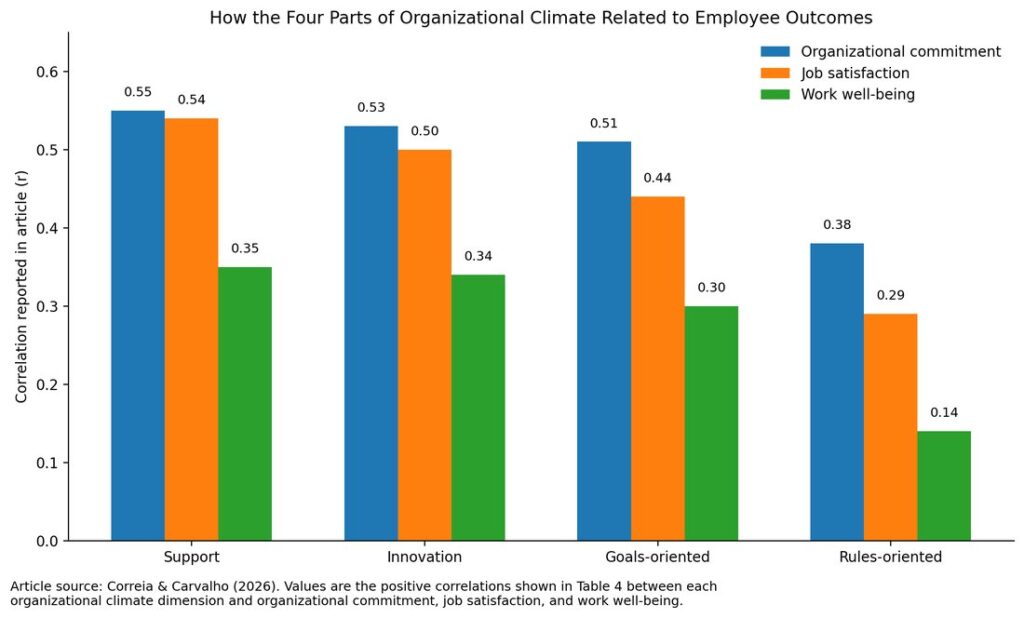
The climate findings are especially useful for managers because the authors broke climate into four parts: support, innovation, goals, and rules. All four were positively related to commitment, job satisfaction, and well-being, though not equally. A supportive climate helped explain higher job satisfaction, while a rules-oriented climate helped explain part of the link between organizational commitment and work well-being. The takeaway is that workplace climate is not just a vague idea about culture. Different features of the environment may shape different employee outcomes.
The findings on meaningful work also matter. Employees who experienced their work as more purposeful and significant tended to report better work well-being, and meaning of work helped explain part of the relationship between organizational commitment and well-being. That does not mean meaningful work explains everything, but it does suggest that feeling that one’s work matters is closely tied to how employees feel emotionally at work.
There are important limits. This was a cross-sectional, observational study based on a convenience sample from mixed work settings in Portugal. That means the findings are correlational, not causal. The study cannot tell us whether commitment leads to satisfaction, whether satisfaction strengthens commitment, or whether both are shaped by something else. But it also tells us that employers across the globe are asking the same questions about their workforces and workplaces.
Before the Week Ends, Make One Change
The first challenge is to look and listen more carefully to your employees. The second challenge comes after that. Before this week ends, choose one concrete action that more clearly communicates value to your employees. Ask one better question. Give one more specific acknowledgment. Listen longer before responding. Notice who has gone quiet and follow up. Then rate your own commitment to making that change on a scale from 1 to 10. If the number is low, ask yourself why. That answer may tell you as much about your workplace climate as any survey.
Reference
Graph developed by ChatGPT from data presented in article.